Here at Howard Falls, we work to document historical events in Northwestern PA, which over the past 200 years have collectively contributed to shaping both our natural environment and the people who call this area ‘home.’ Invariably, much of that work involves research into the genealogical roots of those who have settled here. While many early pioneers came from well-established New England and Atlantic coastal area families, more recent immigrants also found their way into even the most remote areas of Franklin Township by the mid-1800s. Often, these people left difficult situations in the ‘Old Country,’ seeking a new life for their families in America. The following story of the Patterson family that settled in Franklin Township in the early 1850s epitomizes this struggle for a fresh start in the ‘New World.’
Robert and Jane Patterson were born in Ireland at the beginning of the 19th century. Robert, born in 1797, and Jane, born in 1801, probably married in the mid-1820s and began a family. Over the next two decades, their family grew to six or more children. We know nothing specific about their life in Ireland, but families like the Pattersons generally farmed to support themselves.
In Ireland, much of the economy was associated with growing potatoes; however, in about 1845, a destructive plant disease spread rapidly throughout the country, and one-half of the potato crop that year failed. Over the next seven years, about three-quarters of the crop was lost yearly.
The potato crops didn’t fully recover until 1852. By then, the damage was done. Although estimates vary, it is believed as many as 1 million Irish men, women, and children perished during the Famine, and another 1 to 2 million emigrated from the island to escape poverty and starvation, with many landing in various cities throughout North America and Great Britain. The following graph shows this emigration from Ireland to America during the Great Famine, peaking in 1851.

https://www.statista.com/statistics/1044511/migration-ireland-to-us-1820-1957/
Robert and Jane Patterson found their family in dire straits during this period, and immigration records show that they decided to leave Ireland for America, landing in New York City on September 29, 1848.

The Pattersons weren’t alone in making the voyage; over 100,000 Irish immigrated to America in 1848. The Pattersons made the voyage on the ship “Thomas H. Perkins,” which was built in Medford, Massachusetts, in 1844 by Samuel Lapham for owners John E. Lodge and Henry Cabot.

We will never know how the Pattersons afforded that trip from Liverpool to New York, but records show they could only afford passage in ‘Steerage,’ the lowest class. In the 1850s, the average transatlantic sea voyage was 10–12 days, and steerage passengers slept, ate, and socialized in the same group space. Tickets were about £3.50 British pounds each, about $500 today, and included meager provisions for each person, which they prepared each day themselves.
Often, immigrants were sponsored by relatives already in America, and, likely, members of the Patterson family who had already settled in the New World purchased transportation for them. After landing in New York, they made their way west, and two years later, they were enumerated in the 1850 census taken in Hanover, Chautauqua, NY. That year, many Irish were found in Hanover.
Travel to Chautauqua, NY, almost undoubtedly involved transit on the Erie Canal. The Erie Canal looked like a small river. It was four feet deep and 42 feet wide, stretching 363 miles across New York State. Erie Canal packet boats traveled two miles per hour, costing passengers two to four cents per mile. A trip on a packet boat on the Erie Canal from New York City to Buffalo took around eight days. The price included a berth (place to sit or sleep) and three meals daily.

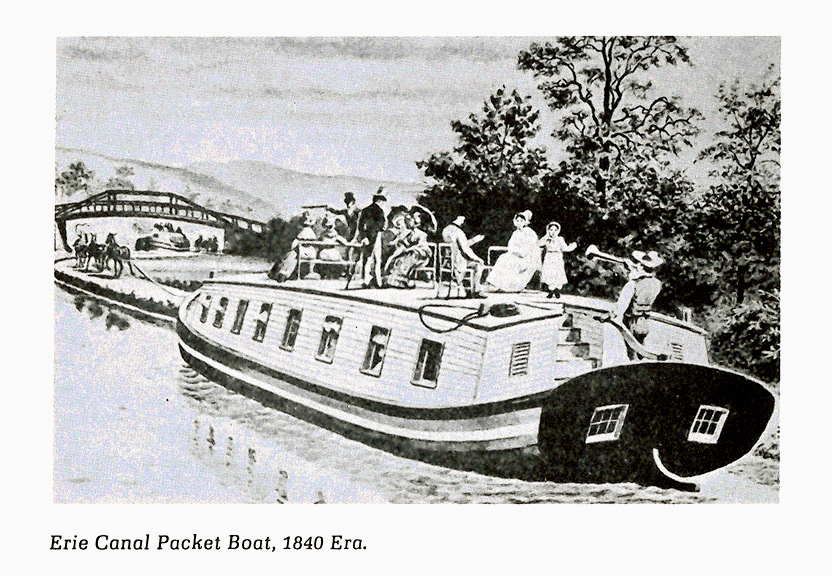
When packet boats reached Buffalo, New York, many passengers boarded steamboats for the three-day journey across Lake Erie to Detroit, Michigan, or Toledo, Ohio. Once in Detroit or Toledo, people could move inland, settling further into Michigan or elsewhere. The Pattersons opted not to do that, probably because their sponsoring relatives were located in Chautauqua, NY. Instead, they made their way the 45 miles from Buffalo to Hanover.
However, the Pattersons soon left Hanover and made their way to Franklin Township, Erie County, PA, by 1854. The motivation for coming here is lost in the mists of time, but it is likely that another relative lived here and encouraged their move.
Soon after the Patterson family settled in Franklin Township, tragedy struck, and the patriarch, Robert Patterson, died on October 17, 1854, and was interred in the Sterrettania Cemetery, just a few miles north of the township. His widow Jane now headed the family and is found in the 1860 census of Franklin Township with her sons Robert, 17, and William, 14. Missing from the household are the girls who accompanied the Patterson to America: Eliza, Mary, and Esther. Then, on April 6, 1882, Jane Patterson died and was interred next to her husband, Robert, at the Sterrettania Cemetery. Along the way, the Patterson family continued to assimilate into the community.
Mary Patterson, daughter of Robert and Jane, married in approximately 1856 to Levi Peach Howard, the oldest son of Henry Howard of the pioneer Howard family at Howard Falls. Levi and Mary were residents of Franklin Township for many years, eventually relocating to Ashtabula County, Ohio, and then to Oxnard, Ventura County, California. They raised two daughters, Kate and Lizzie, who also settled in Oxnard, CA. They are interred in the Santa Paula Cemetery in Ventura, CA.
Robert Patterson, the oldest son of Robert and Jane, remained in Franklin Township, marrying Elizabeth Ormsten about 1868. They raised two girls, Ellen and Mary. Elizabeth passed away in 1880, and Robert in 1925, and both are interred in the Sterrettania Cemetery.
William Patterson, the youngest son of Robert and Jane, married Harriet Ruhl in McKean in 1866. William and Harriet relocated to Merrick County, Nebraska, in 1871, where they remained for the rest of their lives, raising a large, successful family.
Eliza and Esther, the other daughters of Robert and Jane who accompanied them to America, cannot be found. Often, it is difficult to locate women as they marry and take their husbands’ surnames. We can only surmise that is what became of these girls as they reached adulthood.

Epilogue: The Patterson family typifies how immigrant families frequently found new starts in America and became a successful part of the fabric of our great Nation. It is what makes America so unique in the World of today
D.D.Howard
January 2024
One thought on “Coming to America”